


Related

Trading Strategies
Initially used for cryptocurrency trading, stablecoins are becoming an alternative for payment systems that could eventually supplant credit cards.
Charles Rotblut leads a class in AAII's new Essential Investing Video Course. Go to https://www.aaii.com/ves for more information and to subscribe.
Laura Shin is a cryptocurrency journalist, host of the Unchained podcast and author of “The Cryptopians: Idealism, Greed, Lies, and the Making of the First Big Cryptocurrency Craze” (PublicAffairs, 2022). I talked with Shin in early May about the role of stablecoins in financial transactions as Congress considers the Digital Asset Market Clarity Act of 2025 (the Clarity Act). Unchained partners with AAII on the Bits + Bips newsletter.
—Charles Rotblut, CFA
Charles Rotblut: What is a stablecoin?
Laura Shin: If we zoom out to the most abstract definition, a stablecoin is any digital asset whose value is pegged to that of another asset that is perceived to have a relatively stable value. That’s the most generic way to think about the term. But in a pragmatic sense, most people use the term colloquially to mean a digital token whose value is correlated 1-to-1 with the U.S. dollar. This is because 99% of all stablecoins are U.S.-dollar denominated.
An in-between definition will probably emerge when that is no longer the case. But right now, U.S.-dollar stablecoins are so dominant that when people say the word stablecoin, they are usually referring to a U.S.-dollar stablecoin.
Interestingly, stablecoins have very little permeation—especially in the U.S.—among everyday people. However, if you add up all the stablecoins worldwide, they already have a total market capitalization of $320 billion. A lot of the activity in stablecoins is occurring outside of the U.S.
What are stablecoins currently being used for?
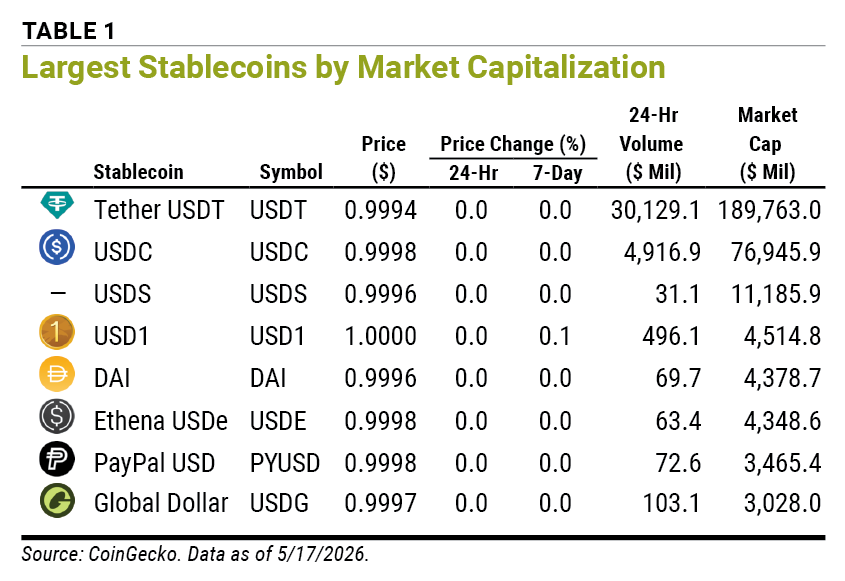
Initially, they were used quite a lot for trading on cryptocurrency exchanges, like trading pairs. Tether, also called USDT, was one of the first stablecoins to really take off, and it is the biggest today (Table 1). On exchanges, the Tether and bitcoin trading pair frequently has the biggest volume.
The primary use of stablecoins is now switching to payments. Payment processor Stripe is getting into this in a big way with a new blockchain, called Tempo, that it has incubated.
In the U.S., Circle, the issuer of the USDC stablecoin, has already made a lot of inroads, especially with Coinbase. Coinbase is Circle’s biggest and probably most important partner.
Stablecoins are also being used for borrowing. For instance, consider people in decentralized finance (DeFi) who hold a digital asset like ether. While they don’t want to sell it because they believe its value will increase significantly over the coming years, they do want to get liquidity out of the position. With a stablecoin, they can create a loan for themselves by putting up the asset and then borrowing against that asset. When they do this, they borrow stablecoins.
Additionally, in foreign countries, people use U.S.-dollar-denominated stablecoins to transact in their own country, as well as for their own savings. For example, Argentinians got into cryptocurrency very early, simply because they experience a lot of hyperinflation. Countries that have been experiencing issues with their own fiat currencies like Turkey and Venezuela began turning to these U.S.-dollar-denominated stablecoins because they offer access to the U.S. dollar without the need for a U.S. bank account. That was one of the biggest drivers of adoption. It’s a huge portion of that $320 billion market cap.
In the future, are stablecoins forecast to become an alternative for payment systems here in the U.S.?
This has already started to happen, but it’s probably going to become more supercharged for a number of reasons. I expect that merchants will realize that all the payments they’ve been making to the credit card issuers can be used as incentives to foster more economic activity from their own customers and create a tighter bond with them.
Think about how the credit card rewards system works now. Banks and card issuers take 3% of every transaction as a fee. That money is then used for all rewards programs: airline miles, cash back, discounts, etc. Merchants are going to realize that they can use the money spent on credit card fees to create a rewards system that incentivizes people to pay with stablecoins at a lower cost. For instance, merchants will tell a shopper that if they spend $500 at their store in the next three months using stablecoins, they will give the shopper a $50 gift card. That’s probably going to eat away at credit card activity.
In my opinion, consumers may not see much of a difference between a credit card and stablecoin, because they will still be getting rewarded. The rewards programs are just going to be styled a bit differently and tied to these stablecoin payments. The company offering those rewards will shift away from the card issuers and to the merchants themselves.
Right now, would somebody wanting to transact in stablecoins have to buy them?
Yes. The way I think about stablecoins is very similar to those America Online (AOL) compact discs. Back in the day, AOL was the gateway to the internet for many people. It was a closed system—a comfortable AOL-branded universe that basically taught people how to get online and how the internet worked. It was like training wheels. Then at a certain point, people realized that they could just be on the internet without the training wheels.
I think the same thing is going to happen with stablecoins. Through the use of stablecoins, people will learn the behaviors they need to adopt to safely transact “onchain.”
As you probably know, there are a lot of security issues happening in crypto right now, especially with the advent of artificial intelligence (AI). The hacks are pretty relentless. The maturation of AI and the maturation of the security of crypto are not happening at the same speed. We just saw a month [April] with a huge number of hacks in crypto, a couple of them for hundreds of millions of dollars.
When you transact with any crypto, including stablecoins, you have to do it in a certain way to keep your money secure. This is different from how people are used to keeping their bank accounts and credit cards secure, since you can always call the bank and have them reverse a fraudulent charge. So, I believe that there will be a “training wheels” period where people will get used to crypto by using stablecoins. Then, once they become comfortable with that, they’re probably going to go on the “open internet” version of this new revolution.
In crypto, we call that “onchain.” Instead of saying that you’re online, we say that you’re doing this or that onchain. This literally means that you are using your own wallet as opposed to using Coinbase or any other intermediary. It’s very similar to paying somebody with cash. When you’re transacting onchain, you are in control of your money and you’re not outsourcing to a third party to manage the payment or custody for you. When you transact onchain, it’s like you yourself are directly working with the blockchain to make a payment or borrow.
We think you’d like this related webinar! The Smart Investor’s 2026 Guide to Crypto
Some early stablecoins, such as TerraUSD, crashed. How does a person determine whether a stablecoin is safe or backed by fiat assets like the U.S. dollar?
The good news is that because of the passage of the GENIUS Act last year, it’s a lot easier to tell now than it was before. [The Guiding and Establishing National Innovation for U.S. Stablecoins (GENIUS) Act is a federal law establishing a regulatory framework for stablecoins.] That law includes a very strict definition of stablecoins.
The example you gave of TerraUSD was from a time when the crypto industry applied the very broad term “stablecoin” to multiple different structures that really didn’t resemble each other. Even if their goal was to have a stablecoin, they were structured so differently that they were really different animals.
The GENIUS Act codifies that the most secure, safest version of that structure is the only one that can be defined as a stablecoin. The law limits the term stablecoin to reserve-backed coins. Basically, those are coins that are designed with a company—usually a private company—as the centralized issuer. It’s just one company that is identifiable and has a legal entity. This is very different from other parts of crypto, where decentralization is the norm and there is often a community managing this network rather than one company in charge.
Sometimes, those in the decentralized finance world don’t like centralized things, as centralization can create single points of failure. In that side of the onchain world, they would say that any point of centralization creates a security risk. But, for the purposes of where we are right now, for creating an asset that has a stable price, we are going with a stablecoin that has a centralized issuer whose job is to mint the stablecoins. They can only mint stablecoins when they hold enough assets in reserve that can back those coins.
Those reserve assets must be limited to those allowed by the GENIUS Act. They are all U.S. dollars or U.S.-dollar equivalents. The list obviously includes cash, but assets like short-term Treasurys, repurchase agreements, money market funds, etc., are also allowed. They must be liquid and from that universe of instruments.
Additionally, there was a period where, depending on how you looked (or squinted) at the law, stablecoins could potentially be securities or commodities. The GENIUS Act ended that interpretation by explicitly stating that if stablecoins are structured in a certain way, they are not securities or commodities.
That’s why TerraUSD was so different. It was called an algorithmic stablecoin. The way it functioned had more to do with creating a whole ecosystem where there were different assets that had a fluctuating value. The activity in the whole system would determine how the peg between TerraUSD and the dollar worked. It was much more complicated than typical stablecoins.
Frankly, in a way, it was not that different from a fiat currency, which fluctuates in relation to other currencies. But it was so nascent. It didn’t have a real economy. It was a start-up project. There were also certain fraudulent aspects to what it promised. Ultimately, TerraUSD’s structure was a big reason why it crashed and failed. It was nowhere close to something that was backed 1-to-1, and it had a very complicated structure. The point is, we don’t even use the term stablecoin to describe that type of asset anymore.
As we talk in early May, Congress recently reached a compromise on the Clarity Act to prevent stablecoins from paying a yield. Since we just talked about rewards, what is the difference between a yield and a reward?
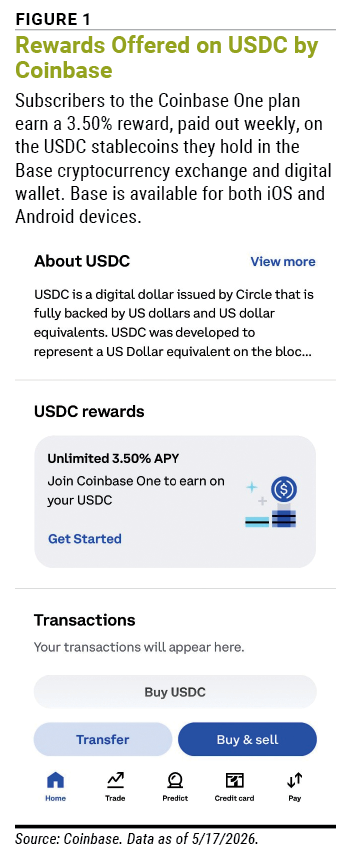
We don’t know yet if that compromise is going to go into law, so we’ll see what happens. But at this moment, because it is not law, Coinbase is offering a 3.50% reward just for passively holding a balance of USDC (Figure 1). USDC is Circle’s stablecoin offered on Coinbase.
The GENIUS Act did include a provision about that, but it was phrased in such a way where the prohibition was on the issuer. This means that Circle cannot pass along interest because it is earning all this money from the reserves that it’s holding.
What Circle has been doing is inking different business deals. For instance, under its deal with Coinbase, I think it has to give all that interest to Coinbase. That’s how Coinbase is offering rewards to participants of its Coinbase One program.
After the GENIUS Act was passed, the banks realized that the prohibition was only on issuers like Circle. This meant that any of Circle’s business partners could pass along the interest to the consumer. The banks were against Circle’s partners, like Coinbase, paying interest on stablecoin out of fear of consumers pulling their deposits.
Many financial technology (fintech) companies have been eating away at bank deposits, even though they are not related to crypto. In my opinion, it’s just competition for savers’ dollars. I think the banks have been seeing deposit flight because they have not been offering competitive products to consumers.
The point is that the banks didn’t realize the nuance of the GENIUS Act’s language, so they basically held the Clarity Act hostage in an attempt to get interest on passive stablecoin balances banned at any partner of a stablecoin issuer.
As a compromise, the narrow phrasing about not offering yield on a passive balance was kept in the Clarity Act, but basically anything else was allowed as a reward. The active rewards phrasing is being used to allow any kind of incentive that deals with activity. If you make a payment, you can be rewarded. If you make a certain number of payments, you can be rewarded. If you provide liquidity to a decentralized finance protocol—meaning that you engage in borrowing or lending—you could earn points. Anything that you do with money can have a reward or incentive attached to it. That’s the distinction that was made.
Interestingly, this is the opposite of how we think of banking. In banking, you earn more for putting your money in savings than in a checking account. But in the crypto world, you will get rewarded for transacting instead of passively saving.
JPMorgan Chase & Co.  (JPM) is now using deposit tokens. Some other banks are using them too. How does a deposit token differ from a stablecoin?
I know it’s confusing. On the surface, they seem very similar. Both have a value that is seemingly pegged to the value of a dollar. But, as I’m sure you’re aware, the way banking works is that they only keep a fraction of the actual liabilities they owe to the customer. Just to keep it simple, let’s say that a bank is holding $100 of its customers’ money. It will only keep 10%, or $10, of that money and loan out the other $90. The bank is making money from loaning out its customers’ deposits.
The deposit token represents the fractional reserve of the bank. It is the dollar-equivalent value of your deposits. The issue with this deposit token is that it is permissioned. It only exists in a walled garden. With a stablecoin like USDC, you could pay for groceries at Walmart or you could buy a craft item at an Etsy shop. One USDC has a value of $1 regardless of where you spend it, but a deposit token is tied with a specific bank. You can only use JPMorgan Chase’s deposit token if you are a JPMorgan Chase customer, so it can’t be used by the wider public at retail stores.
Cryptocurrency is no longer fringe, and understanding digital assets matters more than ever.
Since launching in November 2025, AAII’s Bits + Bips newsletter has covered bitcoin price movements and momentum, year-ahead market outlooks, stablecoin developments, regulatory updates, and trends in crypto mining and related stocks.
Whether you’re interested in investing in crypto or simply want to stay informed about how crypto is shaping traditional finance, Bits + Bips has much more planned for 2026. Join now!
Trading Strategies

Alternative Investments

ETFs and Mutual Funds

JOHN L from NJ posted 4 months ago:
ROBERT A from NC posted 4 months ago:
MONK JR. M from TX posted 4 months ago:
BARRY J from TX posted 4 months ago:
BARRY J from TX posted 4 months ago:
BARRY J from TX posted 4 months ago:
You need to log in as a registered AAII user before commenting.
Log InCreate an account